Thursday, June 18, 2009

GROUP VIDEO

Music had to be disabled, it was "not authorized by YouTube" but at least the sound works this time!

SCREENPLAY:
Shot 1: Establishing shot of a room from doorway, zooms into room, long shot of bed, tilt up into a high angle shot.
Shot 2: Lady Macbeth in bed twitching and mumbling.
Shot 3: Cut to dream scene: normal day, dressed nice, long shot behind her.
Shot 4: High angle close up of hands in sink, water will be blood right away. It will be in hue colors.
Shot 5: Cut to reaction shot of close up, still hue colors.
Shot 6: Cut to a specific drop of blood in the sink, b&w.
Shot 7: Cut to close up of Lady Macbeths face, hue.
Shot 8: Cut back to Lady Macbeth in bed, back to color.
Shot 9: Zoom in on face of sleeping Lady Macbeth, eyes pop open
Shot 10: Cut to living room. Establishing shot of Doctor and Gentlewoman sitting on the couch.
DOCTOR is talking with GENTLEWOMAN both are sitting on the couch.

DOCTOR: (turns to the Gentlewoman) I have two nights watched with you, but can perceive no truth in you report. When is it she last walked?
GENTLEWOMAN: Since his majesty went into the field, I have seen her rise from her bed, throw her nightgown upon her, unlock her closet, take forth paper, fold it, write upon’t, read it, afterwards seal it, and again return to bed; yet all this while in a most fast sleep.
DOCTOR: (Confused and in deep thought) A great perturbation in nature, to receive at once the benefit of sleep and do the effects of watching! In this slumb’ry agitation, besides her walking and other actual performances, what, at any time, have you heard her say?
Shot 11: Gentlewoman gets up and crosses to kitchen. Opens fridge.
GENTLEWOMAN: That, sir, which I will not report after her.
DOCTOR: (Comforting) You may to me, and ‘tis most meet you should.
GENTLEWOMAN: (In a conspirators tone) Neither to you not anyone, having no witness to confirm my speech.
Shot 12: Gentlewoman closes the door and sees Lady Macbeth.
Shot 13: Cut to long shot of Lady Macbeth as fridge closes, cue shriek.
Shot 14: Reaction shot of Gentlewoman and doctor.
Shot 15: Cut to close up of the doctor.
Shot 16: Cut to close up of Gentlewoman.

GENTLEWOMAN: (Shuts the fridge and sees Lady Macbeth) This is her very guise, and, upon my life, fast asleep! Observe her; stand close.
Shot 17: Long shot of Lady Macbeth , eyes open.
Lady Macbeth gets and appears in a trance like state is unaware of the doctor and gentlewoman.
Shot 18: Close up of doctor.
DOCTOR: (In wonder) How came she by that light?
Shot 19: Long shot of Lady Macbeth moving towards sink.
GENTLEWOMAN: (In an obvious tone, condescending to the doctor) Why, it stood by her. She has a light by her continually. ‘Tis her command.
DOCTOR: (Relief) You see, her eyes are open.
Shot 20: Walking to seats
GENTLEWOMAN: (Beginning to get frustrated) Ay, but their sense are shut.
Shot 21: Reaction shot of Gentlewoman and Doctor
DOCTOR: (Scientific and observational sounding) What is it she does now? Look, how she rubs her hands.
GENTLEWOMAN: (Lady Macbeth washes her hands in basin) It is an accustomed action with her, to seem thus washing her hands: I have known her continue this a quarter of an hour.
Shot 22: Close up of Lady Macbeth
LADY MACBETH: (Lady Macbeth washes hard and talks down to her hands) Out, damned spot! Out, I say! One: two: why, then ‘tis time to do’t. Hell is murky. Fie, my lord, fie! A soldier, and afeared? What need we fear who knows it, when none can call our pow’r to accompt? Yet who would have thought the old man to have had so much blood in him?
Shot 23: Fade to another close up of Lady Macbeth
LADY MACBETH: (afraid and in despair) The Thane of Fife had a wife. Where is she now? What, will these hands ne’er be clean? No more o’ that, my lord, no more o’ that! You mar all with this starting.
Shot 23: Reaction shot of Doctor and Gentlewoman
DOCTOR: (Alarmed) Go to, go to! You have known what you should not.
GENTLEWOMAN: (resigned) She has spoke that she should not, I am sure of that. Heaven knows what she has shown.
Shot 24: Cut to close up of Lady Macbeth
LADY MACBETH: (Frightened and regretful) Here’s the smell of the blood still. All the perfumes of Arabia will not sweeten this little hand. Oh, oh, oh!
Shot 25: Cut to reaction shot of Gentlewoman and doctor
DOCTOR: What a sigh is there. The heart is sorely charged.
GENTLEWOMAN: ( Sympathetic) I would not have such a heart in my bosom for the dignity of the whole body.
DOCTOR: Well, well, well-
GENTLEWOMAN: Pray God it be, sir.
Doctor: This disease is beyond my practice. Yet I have known those which have walked in their sleep who have died holily in their beds.
Shot 26: Cut to Lady Macbeth. Begin dolly shot as she goes back to bed
LADY MACBETH: Wash your hands; put on your nightgown; look not so pale! I tell you yet again, Banquo’s buried. He cannot come out on’s grave.
Lady Macbeth goes back to her bed.
Shot 27: Reaction shot of Gentlewoman and Doctor
DOCTOR: Will she go back to bed?
GENTLEWOMAN: Directly.
Shot 28: sitting in circle panning to each person
THREE PROPHETS: Foul whisp’rings are abroad. Unnatural deeds do breed unnatural troubles. Infected minds to deaf pillows will discharge their secrets. More needs she the divine than the physician. God, God forgive us all! Look after her; remove from her the means of all annoyance, and still keep eyes upon her. So good night. My mind she has mated and amazed my sight: I think, but dare not speak.
ALL: Good night!

Wednesday, June 17, 2009

Scene Analysis

The musical Rent is one that can be described as a musical that expresses the complex emotions of lower class New Yorkers. The opening scene starts the movie off with the idea that these people do not hold back these complex emotions. The producers of the movie Rent used continuous shots of panning and tilting around the scene and burning papers as symbols to convey the anger and despair of the tenants living in the apartment; that they are united as once to fight against just one man.
The opening scene of the movie Rent is crucial in establishing the idea that the people of this apartment complex are together as one in the fight against their landlord. As the song progresses, several shots are of the apartment complex in a long shot; where you can see all the residents on their balconies in anger. These shots then pan and tilt around the complex in one continuous shot. By having these continuous shots, it conveys the idea that every person singing on their balcony has the same actions and reactions to their landlord.
The continuous shots also convey the idea that the people are seen as one. By cutting it into individual shots, a producer gives the idea that each shot gives a different reaction to a situation. This producer, however, wants to show the unity of the residents, and therefore, uses one continuous shot. Every resident contains anger and despair, and by using one continuous shot, the producer tells the audience that they all feel the same way and come together as one group to protest. This emotion in the opening scene can be felt throughout the movie and is established through this scene.
As the song progresses and the residents began to get more angry, flaming papers are thrown off of a balcony and sets off the tone of anger. The burning paper is a symbol of this anger; and as more flaming papers fall to the ground beneath the apartments, the angrier and more animated the residents become. The flames continue to fall throughout the scene and are often the focal point. The large amount of burning papers that fall also show the large number of residents who are angry at this landlord and that they all express this emotion together.
The lighting of the scene is very dark, which contrasts with the brightness of the flaming papers, thus attracting the audience to the bright flames. The producers chose to make the flames stand out in order to emphasize the importance of what the flames represent, the heated anger that the residents feel towards their landlord. As the papers fall down to the ground, more and more people come down as well to surround their landlord. By emphasizing the flames, the producers make this symbol obvious to the audience.
Rent is a musical that shows the emotions of the lower class New Yorkers that live day by day. The opening scene conveys the idea of a group of residents of an apartment complex who are finally expressing their anger towards an unfair landlord. Their anger can be seen not only through the song itself, but through the bright flaming papers flying through the scene, and their unity to fight as one against their landlord can be seen through the continuous shots, where it continually pans and tilts around the apartment complex. These two editing techniques lead to the idea that when an emotion as strong as their anger needs to be heard, coming together as one is the loudest way possible.

Thursday, June 11, 2009

Film Journal 2

Description of the scene
Pre-scene: the first thing the viewer sees is two men throwing paper in a bucket. The room is very dark, the fire in the bucket is very bright. The camera zooms in a circle.

Running Time: 1:01
Shot 1: Long shot of two men throwing papers in fire
Shot 2: Cut to the men picking up the bin and walking towards balcony, onto the balcony, and throw the papers out
Shot 3: Cut to shot of entire apartment complex, dolly shot of papers falling
Shot 4: Close up of the street
Shot 5: Cut to a close up of a specific car as it slows to a stop and others come running up
Shot 6: Car stops, man comes out
Shot 7: Man walks out of car
Shot 8: Cut to the two men; low angle shot; shouting in song at the man down below
Shot 9: Cut to close up of two men; no angle
Shot 10: Cut back to low angle shot
Shot 11: Cut to another balcony; low angle shot
Shot 12: Cut to apartment complex; dolly shot of papers flying down
Shot 13: Cut to silhouette of a man on top of a car
Shot 14: Cut to a woman on the balcony; high angle shot
Shot 15: Cut to street level; man in the center, everyone around him yelling at him in song
Shot 16: Cut to apartment complex; flaming papers continue to fall
Shot 17: Cut to balcony of two men; low angle shot; the men are very animated
Shot 18: Cut to other balconies; panning to different balconies of people singing animately
Shot 19: Cut to high angle shot of people on the ground who are all singing up at the people in the balconies
Shot 20: Cut to random men in balcony
Shot 21: Cut to entire complex. Panning and tilting around, until song and scene ends.
end of scene
Shot 20:

Thursday, June 4, 2009

Film Journal 1

Movie: Rent

Scene: The end of the opening scene

Scene Running Time: The last 1:01 will be analyzed of the total scene.


Description of the scene: This last portion of the scene opens up with two men dumping a bin full of flaming papers out onto the street. It starts with the camera tilting up on the two men with a close up of just them before moving into the establishing shot of the entire apartment complex. The lighting is very dark, which brings out the color of the flaming papers that are fluttering down. It turns into a dolly shot as the camera follows the paper move down onto the street of cars. There is then a close up of a particular car that is on the street. The lighting continues to be dark and the focus continues to be on the flaming papers. The "noir" of this scene then jumps out of the car. He is dressed all in black, in the bad part of town. There is a dolly shot of him as he begins to sing his complaints. The shots shift between this man and the two men that are still up on the balcony as they shout at each other in song. The shot of the two men begin as a low angle shot before moving into a regular close up shot. As the song progresses, the camera pans around the apartment complex as everybody contributes to the flaming papers. All shots of people on the balconies are low angle shots. The scene ends with a low angle shot on the street, with the Noir guy standing in the middle of a crowd who is yelling at him. It then goes into another establishing shot before a low angle shot of the two men. It then pans and tilts around the complex again, before completely ending with the original two men.

Wednesday, May 13, 2009

Journal 14

During Creon and Antigone's argument Anouilh repeats many words and ideas. Choose a word or idea and discuss how Anouilh uses the term.

"You've said your yes" (Anouilh 35). Throughout their argument, Antigone often and simply says the word "yes" with an occasional "no". These one word answers are short, yet have such a finality to them. Anouilh uses this term to show the determination Antigone has to bury her brother. By simply saying "yes" with no other explanation, she has no reason to believe otherwise.

Sometimes Anouilh uses ambiguous terms, identify how the terms affect your interpretation of characters and their motivations.

The word "power" and words associated with it are often used. This word is used in many different ways. Creon has power because he is king. Antigone has power because she believes Creon fears her. Nurse has power because Antigone sees her as a strong woman. All of these different forms of power makes each character unique in what they have, what they want and what they need to achieve.

Tuesday, May 12, 2009

Journal 13

Anouilh's Antigone: Antigone

In this particular scene, Antigone begs for Nanny's protection. To everybody else, Antigone seems strong, daring, getting what she wants. But to the nurse, she is nothing more than just an ignorant little girl that needs the guidence and help that the nanny gives her. Antigone knows what she has done is bad and what the punishment is, so in this scene, her motivation is for the nurse to take care of her dog after Antigone passes. Though this may seem childish and unimporant to the plot, it is very important because it's a little part of the big picture that is being illustrated. Antigone knows that she will die; she knows what the consequence is going to be and yet she still buries her brother.

Journal 11

what do you know about the 1940s in Europe and how do you predict that will influence Anouilh's version of Antigone?

I know that the 1940s was a bad time in Europe, because you had the communists in the Soviet Union that was attacking from the east and the rise of the Nazis in central Europe. Hitler dominated much of Europe and took over many countries there. It will influence Anouilh's version of Antigone in that his interpretation will be altered according to his life, which at the moment is ravaged by the world war. Anouilh is French; and the French defeat by Germany was a huge event in that decade.

Wednesday, May 6, 2009

Journal 9

Knowledge Level
- Who is Haemon, and when was he introduced into the play?
- How did Creon react to Ismene when she defended her sister?


Comprehension Level
- Why was Creon so upset at Ismene?
- What is foreshadowed in this reading?


Application Level
- How can we relate Creon's power to political power in the world today?
- Can you relate to Ismene's and Haemon's family values?


Analysis
- Why does Antigone seem to embrace death?
- "What? The city is the king's - that's the law!" (line 825). Explain how Antigone's Creon compares to Oedipus when it comes to being king.


Synthesis
- How is the role of women even further shown in this reading? What is the role of women?
- Give examples of how the theme of family has come up in this reading, and how it is revealed.


Evaluation
- What made Haemon change his mind and decide to defend Antigone instead of his father?
- Why did Ismene go against what she believed to side with Antigone?

Tuesday, May 5, 2009

My lovely computer got a virus - internet access was very slim, so all of my journals from the past few days will be posted on this post. Still in order, but not as organized as it would have been.

Journal Eight
Compare the elements of tragedy in Medea and Oedipus. Look specifically at at the use of catharsis.

The elements of tragedy in Medea and Oepidus differ in that the use of catharsis is in opposite parts of the plays. In Oepdipus, the audience does not feel pity for him until the end of the play, and Medea starts off with the audience fearing her instantly. Though these are both at different parts of each play, the element of tragedy is just as strong in both. The fact that we do not pity Oedipus at first builds tension and suspense, creating even more sympathy towards him in the end because we know how much fate played into his life and how much it is not his fault. The instant fear in Medea creates tragedy because we know how angry Medea is and how her actions are not reasonable because of that. We then feel pity for her towards the end because Medea's anger is what drove her, as our fear of her turns into pity because throughout the play we learn more about her and her situation.

Journal Seven
Compare and contrast Jason and Medea's interactions and attitudes towards the gods.

Jason sees the gods as people who serve him, and he expects them to help him when he needs them, whereas Medea sort of sees them as her friend, people who help guide her and help her when they think she needs help. "It was Aphrodite and no one else [...] who saved me on my voyage" (line 528). Jason believes that he was only saved because a god saved him, and no other reason.

Journal Six
Comapre the role of the chorus in Medea and Oedipus.


The role of the chorus in Oedipus seemed to be just for the audience's purpose. The chorus summarized what happened in the play, occasionally foreshadowed, and was completely seperate from the play itself. It's as if the chorus was just a commentator, showing the play-by-play. However, in Medea, the chorus played a bigger role in the actual play. They interacted with the characters, and even felt for them, especially Medea. They seemed sympathetic towards her whereas in Oedipus they had no emotions towards the characters.


Journal Five
Sophocles provokes fear in the audience in that though we may not all be a king, we all posess the ability to have a certain amount of power, and that it is up to ourselves to control the consequences that come with have power. Oedipus is an example of a man who takes advantage of his power to the extreme, thus bringing his downfall. We fear that this may happen to us, if we take our power for granted and have too much pride in ourselves. Sophocles provokes pity in the audience not just because Jocasta and Oedipus punish themselves, but because it was not their fault for having the need to be punished. They were merely a victim of fate, and they didn't even sit back and accept it; they fought fate hard, but fate fought them back and won.

Tuesday, April 28, 2009

Journal 3

What are the gender roles that Sophocles establishes for men and women? Based on Jocasta's response to her husband and brother, do you think she is a strong model of how women should act or is she a warning to women? What about Oedipus' or Creon's actions? How do the genders speak to each other and how do they speak to themselves?

The men in Oedipus are aggressive and controlling with much power. They act on their anger and don't think about what the real truth is, their actions seem to be controlled by their emotions without thought. A strong example of this is when Oedipus is angry at the truth and blames everybody else for the situation. He does not believe Tiresias, he blames Creon, etc. The role of women according to Sophocles is seen through Jocasta. Though her emotions drive her actions just as much, she is able to be more sensible with her actions. She is calm, and does not physically lash out at others at her despair. Women seem to accept what they have and accept their fate without fighting it. This is not a strong model for how women should act and shows that women cannot be so passive with their lives.

Sunday, April 26, 2009

Oedipus 2

Does Oedipus demonstrate the qualities of a proficient or deficient leader? Examine Oedipus' actions and word choice. As you continue to read, how does your impression of Oedipus change? How would you describe the personalities of Creon and Teiresias?

Oedipus has shown from the beginning that he has the qualities of a strong leader. He is not afraid to speak his mind and speak for his people. He has the defensive attitude that a leader needs. Oedipus truly does care for his people, though it seems as if sometimes his power might get in the way. However, he may not be the best leader. He is very quick to judge and cannot seem to accept the truth. When Tiresias comes to tell his prophecy, Oedipus shuts him down instantly.

Creon has a lot of power as well, though he has made it clear that he does not wish to take advantage of his power, and he never wants to be in the powerful position that Oedipus is in. Creon is sort of a juxtaposition to Oedipus; his amount of power and lack of pride brings out the powerhungriness of Oedipus and makes it more clear that Oedipus will bring his own downfall.

Oedipus Summary

159 - People have come to pray and ask for help from Oedipus
160 - Priest asks him for help, the city is crumbling
161 - Although he isn't as great as the gods, he is powerful enough to help restore the city
162 - Oedipus has sent Creon to the oracle to learn how he can save the city
163 - creon has come back from the oracle, and he's about to announce what the gods said
164 - Creon says to cleanse the city from their troubles by banishing the murderer of Laius, a leader and avenging his death
165 - The murderer is in Thebes, and that he went to consult the oracle.
166 - Creon says that theives attacked and killed the king, but Oedipus is skeptical. The Sphinx stopped them from finding the killer
167 - Oedipus is worried that this killer will come and kill him as well, she he's sending the guards to find him
168 - The citizens of Thebes pray to the gods
169 - Continuing to pray the gods, they feel like Thebes is helpless and dying
170 - They continue to ask the gods to help them using their different powers

Wednesday, April 1, 2009

When the Commander asks Offred to play a game of scrabble, she is reluctant. "Now of course it's something dangerous. Now it's forbidden, for us. Now it's dangerous. [...] Now it's desirable" (Atwood 138). Scrabble is a symbol of knowledge in the novel. Atwood uses it to express the reluctance in Offred, where she wants to gain knowledge but knows its dangerous power. Knowledge has become desirable because it is forbidden to them, a temptation that is refrained because of the amount of fear the society has created. This refrainment (wc?) is what oppresses the society. The government just had to create fear, and the rest fell into place.

As Offred plays scrabble with the Commander, she finds it hard to piece together words. "It was like trying to walk without crutches" (Atwood 156). Offred feared her new society so much that she had completely blocked away any prior knowledge that she had before, making it harder for her to play the game. She knew that she was capable of spelling the words correctly, but because she had not used the words in so long, she could not remember. Atwood compares this to a broken leg, where a person is knows how to walk, but needs aid in relearning the skill. This simile shows how much the fear of the society has oppressed any prior knowledge, where knowledge is broken apart so much that it needs to be mended and relearned.

Tuesday, March 31, 2009

Dystopian Thesis

Groupies! We need a thesis!
Blog discussion starts now...

I'll start.
So we like knowledge, fear, and that it's not society that actually oppresses, its the people themselves out of fear.

At least we have a path that we're taking.

Monday, March 30, 2009

Dystopian Outline

Groupies - here are my two quotes and analysis on voice:

1 a. Quote:
b. Analysis:

2. a. Quote:
b. Analysis:

Thursday, March 19, 2009

Dystopian #2

Prompt B

In Handmaid's Tale, the character Moira cannot conform to the new society she is forced in to. Her definition of freedom is different than what the Aunts continue to preach and what the handmaids believe. "In the light of Moira, the Aunts were less fearsome and more absurd." (Atwood 133). The handmaids had given up all their beliefs and listened to the Aunts out of fear. Moira, however, would not. Her  bravery was something that was admired and feared by the other handmaids, for they preferred the freedom to stay alive rather than the freedom to live and risking their lives. The Aunts instill fear in the handmaids; Moira instills fear the Aunts, a relationship that shows the flaws of the society. The resistance that Moira employs is the attempt to kill an Aunt and make them fear her enough to let her be free. However, the attempt is not successful, showing how powerful the society is.  Her punishment was to have her feet be so battered up that she would no longer be able to walk normally again. A physical punishment such as the distortion of a body part is key in keeping the fear in the society. The handmaids are reminded everyday of what could happen if they rebel just by looking at Moira and seeing the pain and embarrassment of it. Moira continually attempts to defy the law throughout the book, whether it's smoking or stabbing an Aunt, and that makes her a key character in the novel because it shows that not every person in this society has conformed. She isn't scared of the government 

WC: 269

Propaganda

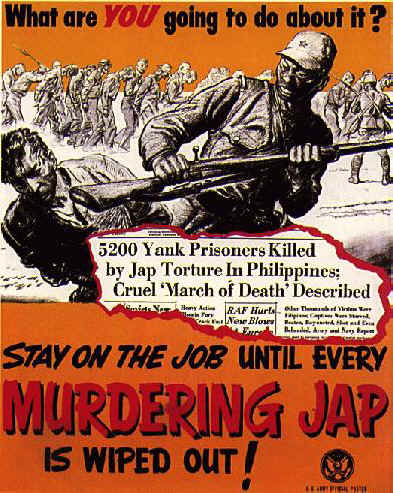
you can find this picture here

This propaganda is targeting the American audience during WWII. It will make the men fight harder because it makes them angry at the Japanese. This poster portrays the Japanese as pure vicious murderous killers with no apparent motive other than to torture and kill. The image of the japanese man kicking the American man down will stay in the men's minds as they fight because it gives them a purpose to fight and want to join the army to wipe out the Japanese. It asks, "What are YOU going to do about it?" and if the man reading it is not in the army and is just sitting at home, it will make him feel guilty and join. It's not misleading, but it does trick Americans into believing the worst in the Japanese. The tone is appropriate to the society because at this time Americans were in the middle of this big global war and needed the extra push to fight instead of sitting back in fear. What doesn't work is the hypocrisy of it. Murder the Japanese because they are murdering us? If we murder the Japanese back we will be just as bad as they are.

Wednesday, March 18, 2009

Dystopian Group

THE HANDMAID'S TALE - ANALYSIS OF THE SYMBOLS OF COLORS

Though the book lacks complex descriptions, Margaret Atwood seems to always describe the apparel of the characters with their colors. "There are several umbrellas in it: black, for the Commander, blue, for the Commander's Wife, and the one assigned to me, which is red." (Atwood 9). Red is often used, as well as blue, white and black. Each color, however, symbolizes the rank of the certain person. The handmaids always dress in red; it symbolizes their fertility, their ability to reproduce. Blue is worn by the Wives. This may be a stretch, but because this society thrives off of religious beliefs, blue is a representation of the Virgin Mary, as the wives are pure, untouched. White is worn by the daughters; a simple symbolization, where it represents their innocence; it is unknown whether or not they are fertile, if they will become unwomen, so they wear white to symbolize the clean slate. And black seems to be a common color for men, though it does not seem as important as the women's colors.

Wednesday, March 11, 2009

Dystopian Journal 1

Prompt A

"The newspaper stories were like dreams to us, bad dreams dreamt by others. How awful, we would say, and they were, but they were awful without being believable. They were too melodramatic, they had a dimension that was not the dimension of our lives. We were the people who were not in the papers. We lived in blank white spaces at the edges of print. It gave us more freedom. We lived in the gaps between the stories" (Atwood 56-57).

What is revealed about society from this passage?
People sit back because they are afraid to be different. In this society, being different, being outspoken, is dangerous, giving more emphasis on the fear of being different. The fertile women were blessed with the fact that they are able to bear children; it helps them blend in better. The society that is revealed shows that conformity is key in be able to be free; however, it is a different kind of free. To be different, and to get away with it, is liberation. But the kind of freedom you get from conforming into this society is the freedom to stay alive. Those who attempted to break the barriers of this society were put on display by these newspaper stories; showing that fear is key in this society. "Awful without being believable" - meaning, those who have chosen to conform to this society are led to believe that everybody is a conformist, and that nobody tries to break the barriers of this society. Though, without these people who tried to liberate themselves, the women who suffered to conform would no longer be able to live in the shadows.


word count - 188

Wednesday, March 4, 2009

ULGH

I can't figure out how to do outlining in Word! I followed the directions and nothing happens when I hit tab. Outlining would be a hundred times faster if I didn't have to manually drag everything to fit. So Frustrating. This just adds to my horrible week.

Tuesday, March 3, 2009

New Thesis

It's tweaked - I'm trying to only focus on one point, but it's hard because I want to write on so much!

Though to some it may seem to be a hindrance, Camus creates Mersault to accept the fact that he is only able to express himself physically with the inability to evoke emotion, which can be seen through the symbols of the sun, death, and his relationship with Marie.
What conclusion does Meursault come to at the end of the text? Does Camus want the reader to come to the same conclusion? Do you believe Meursault is happier or less happy at the end of the novel?

Mersault seems to come to the conclusion that no matter how different he seems to be from the rest of the world - the world actually possesses a kind of indifference, something that Mersault can relate to. I like that at the end, he shows emotion towards his mother, when before, he couldn't relate. Now that he himself was about to face death, he understood the emotions of his mother. These conclusions seem to give Mersault a sense of closure on his isolated life, a conclusion that Camus wanted the reader to feel as well, this book was very well-rounded and gave you a sense of a peaceful ending despite the fact that he is going to be executed.

Monday, March 2, 2009

Journal #6

Thesis:
Through the philosophy that
a man's life is his own responsibility, Mersault has built a wall between himself and society, where he is capable of expressing himself physically yet he cannot evoke meaningful thoughts and feelings, as can be seen through the symbols of the sun, darkness and death.


So here is my thought process...
- Question: Why does Camus keep Mersault's thoughts vague even though he is the narrator of the story?
- Mersault is telling a story without really investing any thoughts or feelings into the events
- The lack of knowledge of Mersault's thought process actually develops Mersault's character
- It shows how Mersault creates a wall between him and the world
- This barrier causes him to be convicted of murder, I could use the example of his mother, I really love that his philosophy impacts his reaction to his mother's death.
- Mersault is not able to express himself verbally, though he can go into detail on himself physically. He went into great detail of his physical feelings when he shot the Arab rather than his mentality.
- Though he did express that he had shattered his happiness, that rare look into his mentality was super vague
- Mersault really begins to open up in the last chapter, when he knows that he is about to die, we are really able to look into how he thinks
- The fact that this is the only time we really have a good look inside Mersault's mind makes it stand out even more.
- To incorporate the sun into my analysis: Mersault really expresses his feelings through the physical presence of the sun and how it affects him physically.
- Philosophy that a person's way of life is their choice and responsibility, therefore, it is Mersault's fault for his isolation. How to word that concisely..?!

Sunday, March 1, 2009

Journal Number Whaaa?

Why does Camus create a part 1 and a part 2? Identify parallel ideas or scenes that occur between the two parts. What does Camus accomplish by comparing ideas between the two parts?

Camus creates two parts to identify Mersault's choice in a simplictic life and him being forced to live simplictic. Simplictic, is that a word? By being put in jail, Mersault begins to actually think about his life, and his consequences for his actions, rather than living by the minute as he had before. It is a great way to further develop Mersault without making him any different. The fact that Mersault's actions when his mother died caused him to be executed really makes you feel for the guy - I mean, before, this was just a story about a man who can't really get his feelings across, and now, because of that, he's about to die. His view on life is somewhat morbid, and yet, it's his own philosophy, and it helps further understand his way of thinking: "Since we're all going to die, it's obvious that when and how doesn't matter." (114). This really ties back to Maman dying at the very beginning of the book, especially since Mersault wasn't sure exactly when she died, or how old she was. It ties the story together really well.

Thursday, February 26, 2009

Journal #4

Hows does my philosophy affect my reading?

First of all, I respect everyone's religious beliefs and I believe that everyone is entitled to their beliefs, so I found it quite irritating when Mersault's lawer thrusted a crucifix at him, demanding him to put his trust in God. If you don't believe in God, that is your thing, and I don't think it is right to force beliefs on other people, especially when they clearly do not agree. I also respect that Mersault does not look towards the bigger picture, especially when it comes to marriage, and I find it even more interesting because I'm the type of person that believes the now will always affect my future.

Journal #4

Word Choice
- Either Camus uses a simple vocabulary, or Ward chose to translate it that way.
-Did not translate "Maman" and uses kilometers instead of miles.
Question: Is there an underlying reason for Camus' choice in lower level words?

Sentences
- Choppy sentence paragraph followed by a descriptive paragraph with fuller sentences
- No rhetorical questions
- Sentences, even choppy ones, are complete.
Question: Did Camus write with choppy sentences to annoy me? Haha, kidding, but I find it harder to read.
Actual Question: Why does Camus vary the sentence structure/length? Is he trying to emphasize something?

Images
- Uses "blood" to describe colors
- Images are used to describe his physical sense, never his mentality.
Question: Why does Camus often describe darkness next to brightness?
example: "From a distance I could see the small, dark mass of rock surrounded by a blinding halo of light and sea spray." (57)

Symbols
-The Sun and the heat
- Brightness vs Darkness
Question: What message is Camus trying to convey with the motif of the sun?

Figures of Speech
- Personification
Question: Why doesn't Camus use more figures of speech? Does the lack of it contrivute to our perception of Mersault?

Rhetorical Devices
- First sentence of pretty much all chapters is a statement of a short fact.
Question: Why does Camus choose state a concise fact at the beginning of every chapter?

Patterns
- Motif of describing things using "blood" or "red"
- Motif of the sun, of course
- Brightness vs Darkness
- Sun = Sleepy
Question: Why does brightness bring discomfort to Mersault?

Narrators
- First person
- We can't read into his thoughts as much as we normally would in a first person narrative
Question: Why does Camus write this in first person narrative, if he doesn't express Mersault's feelings at particular times?

Structure
- Chronological order
Question: Why does Camus pause to describe in fuller details of certain scenes, and not others?

Wednesday, February 25, 2009

Journal 3

The Sun:
"I was so tired and also because we hadn't opened the blinds, the day, already bright with sun, hit me like a slap in the face." (47)
- Mersault always seems to become sleepy when he sees the sun, which I find ironic.

"But the whole beach, throbbing in the sun, was pressing on my back." (58).
- Possible personification/symbol for Mersault's instincts that usually are given into without a second thought, but are now stopped by his conscience.

Red:
"There was the same dazzling red glare." (57)
- This was right before Mersault committed murder, and is an example of when he actually invested thought into his life, deciding whether or not to shoot the trigger, instead of always going with his instincts.

Tuesday, February 24, 2009

Journal #3

Destinism
To live life means to strive for an ideal reality for yourself, and accepting that God has set that path for you, and it is up to you whether you want to continually find that path.
  • To take in the richness and beauty of this world, one must find what makes them happy. (Happiness is what makes you rich and empowers you with success, not purely money. Money may be a component in happiness, but it's not the main goal.)
  • God challenges you when he feels you have lost touch with your ideal reality.
    (These challenges are the choices we have to make in life, and most are based on judgement - drinking and driving, dropping out of school, taking IB...)
  • Your destiny is predetermined.
    (It is up to the person to decide if they want to live out their destiny. Do I want to be a full IB diploma candidate, get into an Ivy League, and have a successful career? Or do I just want to drop out of high school and do some drugs in a dark alley?)
  • The destiny is revealed through trial and error.
    (Life has it's ups and downs; challenging yourself and trying new things, seeing your limits and your strengths, will help further your ability to find your destiny.)
  • There must be a degree of acceptance of God to find this ideal reality
    (A track runner can't win gold without a trainer, just as a person can't find his happiness and true self without a helping hand.)
  • A person is able to speak directly to God through prayer.
    (His answers are not in words, but in action.)
  • Your total reality is revealed in the afterlife.
    (The afterlife is created to give you a sense of peace, but it can only be acquired if you confess your sins and live life

Monday, February 23, 2009

Journal #2

Describe Meursault's actions/activities. How do you respond to Meursault's activities? Why would Camus create a protagonist like Mersault - what is he trying to accomplish?

"It occured to me that anyway one more Sunday was over, that Maman was buried now, that I was going back to work, and that, really, nothing had changed" (pg 24). Meursault is going to go back to work tomorrow and it is going to be completely back to normal, as if the weekend's events had absolutely no effect on him. It is kind of appalling to see how casual Meursault is when it comes to his mother's death, and at times, he feels annoyed at the situation. Perhaps he lacks a relationship of any kind with his mother, which can be seen when he is asked how old she is, and he doesn't know. Perhaps he lacks the ability to feel emotion, because the day after her funeral, he goes out on a date, and when Marie asks him about his mother, he casually brushes off the situation. When asked by both Marie and his boss, Meursault is quick to defend the fact that it's not his fault that his mother died. Camus creates a protagonist like Mersault to illustrate a man who seems as though he's living his life on the outside looking in.

Sunday, February 22, 2009

Journal #10

How are the two translations different? What effects does this difference create?

The two translations are different in that one seems to be a lot more personal and detailed than the other. The second (well, my second, I don't know if it's your second...) seems to focus a lot more on the man talking to his boss, as it takes up the majority of the page, whereas on the first side, it was only a couple sentences: "I have fixed up with my employer for two days' leave; obviously, under the circumstances, he couldn't refuse. Still I had the idea he looked annoyed, and I said, without thinking: 'Sorry, sir, but it's not my fault, you know.'" (Page Uno). This creates the effect of two possible plots: first, it could be about the man, and his late mother, or, it could be about man and his job. Who knows. The fact that this difference can give the reader two completely different predictions creates different tones; the first seems to be a lot more impersonal and the second seems more emotional.

Tuesday, February 17, 2009

Journal #9

How does the structure affect the text: re-examine the opening and closing of chapters or the opening and closing of the novel?

The structure gives the text a full roundedness, if that's a word, in that the beginning and end tie together, giving it the closure that it needs and deserves.

and I really do want to finish this, but I have a million hours of homework left to do (hyperbole that is borderline literal) and this will have to be done later.

Monday, February 16, 2009

Journal #8

What is the significance of the title? What does Hurston suggest about the relationship between the characters and God

The significance of the title is the fact that these characters don't believe they have full control of their lives, that God plays a big role in determining certain outcomes. This is shown when Tea Cake worried that Janie regreted the move to the Everglades with a possible impending death, and she argued, "Naw. We been tuhgether round two years. If you kin see de light at day break, you don't keer if you die at dusk. It's so many people never seen de light at all. Ah wuz fumblin' round and God opened de door." (Hurston 159). God didn't necessarily put her and Tea Cake together, but gave her the opportunity to be with him by opening more possibilities. The title "They Eyes Were Watching God" refers to the fact that God controls nature as a way to test his people, and his people are fully aware of this, which is why they “watch” him to see what he has in store next. God had tested Janie with the open door and she took that opportunity. He is now testing the strength of the relationship between Janie and Tea Cake, which proved to be strong in the midst of a deadly storm.

Journal #7

How does Mrs. Turner's relationship with her husband affect her character? Discuss their roles in marriage, and compare them to other couples in the chapters.


Mrs. Turner is unique to the African-American community, in that she strives to be something that she can never be: white. Part of the reason why she is so dominant in her marriage may be due to the fact that she wants so badly to be something that's impossible for her to be. Unlike most marriages in this setting, Mrs. Turner is the dominent spouse in her marriage, where she does all the work while he sits around doing nothing. Mrs. Turner also has the courage to stand up to her husband and even physically slap him. "Mrs. Turner hit him the best she could with her hurt hand and then spoke her mind for half an hour." (Hurston 152). Whereas Janie cried silently when Tea Cake hit her, Mrs. Turner was able to fight back with her husband, similar to Sop-de-Bottom's wife, who often fought back just as hard when he hit her. The marriage between the Turners can be compared to the marriage between Janie and Logan, with opposite gender roles, where Mrs. Turner is the one yelling at her husband about not doing anything, just like Logan had yelled at Janie. This sense of dominance gives Mrs. Turner a better control of her life, a life she wished was different.

Thursday, February 12, 2009

Journal #6

Literary Techniques

Page: 116
Device: Personification
Quote: "The train beat itself and danced on the shiny steal rails mile after mile"
So What? Janie was on her way to moving to Jacksonville to live with Tea Cake. Though she had been excited to marry her first two husbands, the feeling of marrying Tea Cake was different because for once, she fell in love before marriage. The lightheartedness of the way the train moved on the tracks reflects Janie's current state of mind. This personification leaves a light feeling of excitement of what's to come next for Janie. Had it been a more somber ride, the train probably would not have "danced on teh shiny steal rails".

Page: 119
Device: Hyperbole
Quote: "Everything that you could see was hanging. Her chin hung from her ears and rippled down her neck like drapes. Her hanging bosom and stomach and buttocks and legs that draped down over her ankles."
So What? This hyperbole exaggerates Mrs. Tyler, a woman that Janie met in Jacksonville. She was a 52 year old woman who had been left widowed. This hyperbole isn't just used to show how old Mrs. Tyler is, it is used to show how Janie feels compared to Tea Cake. Tea Cake is much younger than Janie, young enough to be frowed upon as a couple, and Janie feels insecure about the age gap. Compared to Tea Cake, she feels old, aging, and feels as if Tea Cake always wants better.

Page: 120
Device: Dialect
Quote: "But oh God, don't let Tea Cake be off somewhere hurt and Ah not know nothing about it. And God, please suh, don't let him love nobody else but me..."
So What? Usually, the dialect is kept to the dialogue, but in this case, the narration had a bit of dialect in it. The dialect was used in order to convey what Janie was feeling at the time - narration would not have been able to fully express her emotion, which is the only con of having a well-articulated narration in this type of novel. However, these are Janie's thoughts - it would be ridiculous to have her say them outloud. I thought that the way Hurston wrote this was the best way to show Janie's worry for Tea Cake, especially when you picture the quote written in a perfectly written way. The worry would not come across as strongly.

Wednesday, February 11, 2009

Journal #5

What motivates Janie? How has Janie changed?

Janie's biggest motivation is her search to find her happiness. Before Logan, Janie had assumed marriage would automatically cause you to fall in love with that person and be happy with them. "Husbands and wives always loved each other, and that is what marriage meant. It was just so." (Hurston, 30.) Janie's hope for the future was crushed by the realization that marriage does not mean love and so she left Logan for Joe, motivated by the need for love and happiness. However, Joe was not the key to her happiness as well, and Tea Cake becomes her third interest. Tea Cake is like a breath of fresh air compared to the previous two. He seems to really care about Janie and her feelings, and appreciates her as a person rather than a woman that must stay and be looked at as just a woman. Janie has changed since Tea Cake in that she's finally letting herself be truly happy, instead of holding it inside, trying to be the woman that she believed everyone wanted her to be. With Joe, Janie conformed to the mold that he had set for her, a mold that kept her from being happy. With Tea Cake, Janie does not care what others think for once, and cares how she feels instead. She is finally able to tune out the outside voices telling her no and letting herself say yes. Aw, I think Tea Cake and Janie are adorable! :)

Tuesday, February 10, 2009

Journal #4?

JEALOUSY...RAWRRRR here we goooooooo...
It's Othello, but I tweaked it to make it work.

Then Othello began to live in jealousy. Jealousy, that green-eyed wicked witch who lives under the house. The great one who waits to jump out from hiding like a snake waiting for its prey. What need has Jealousy for obviousness, and what guards can prevent it from coming out? The witch waits in wonder of what person awaits the change she brings. Waits innocently and vulnerably with her fangs pulled back, waiting for the right moment to strike. Been standing there along with the lying and spying. He was bound to find the witch's legs creep out from under the house any day now. He could not stop it. Poor Othello! He ought not to live by the words of Iago. Desdemona sent Iago to suggest Othello to believe otherwise, but Othello would not listen. Iago wuz all right with giving advice, but he was the one pulling on her legs. He'd be all right just as soon as the two-faced monster showed his true colors. The witch wasn't going to come out at all. That's what Othello thought. But Iago told Desdemona different, so she knew. And then if he hadn't, the next morning she was bound to know, for the witch could no longer be contained under the small white house. A witch that would not dare to set foot on those that could contain her and knew when to stay hidden. Just stayed under the house and waited. Rivalry, that conjurer of destruction, had changed a good man.

Thursday, February 5, 2009

Journal #3

5 Literary Techniques from Chapter 4:

page number: 32
name of technique: Simile
quote for the book: "The morning road air was like a new dress"
so what?! This simile has a very important role in emphasizing what was going on at the time. Janie had met a new man, Joe, who was a stylish man that convinced her that he'd treat her the way she deserves to be treated, unlike the way that Logan, her husband, treats her. "You behind a plow! You ain't got no mo' business wid uh plow than uh hog is got wid uh holiday! You ain't got no business cuttin' up no seed p'taters neither. A pretty doll-baby lak you is made to sit on de front porch and rock and fan yo'self and eat p'taters dat other folks plant just special for you." (page 29). Janie had finally gotten the courage to stand up to her husband and leave him. The morning road air was like a new dress because it was a fresh start. A new dress in a life in Southern America is refreshing, wanted and new, a breath of fresh air.


page number: 27
name of technique: Hyperbole
quote from the book: "The shirt with the silk sleeveholders was dazzling enough for the world."
so what?! This quote comes from the very first description of Joe, the man that would convince Janie to leave her husband for him later in the chapter. This hyperbole was used to emphasize the fact that Joe is a "cityfied, stylish dressed man" (page 27) and created the idea that he is a confident and well off. His confidence flustered Janie and his words captivated her enough to realize that she is better than the life she has now, and that this man, with his confidence radiating from his silk sleeveholders can give her the life she deserves.

page number: 28
name of technique: Dialect
quote from the book: "Joe Staks was the name...Where was Janie's papa and mama?"
so what?! This extensive narrative was written in the southern dialect rather than the well-articulated narration of the rest of the story. This paragraph was Joe's story, who he is and where he came from, as told in his voice, in third person, as if it were a narrative. Joe's story was written in this particular dialect because it is the most accurate way to tell it; it shows that even though he may be dressed like he's from the city, with dazzling sleeveholders, he is still a southernor and was still at the same level as Janie.

page number: 31
name of technique: Metaphor
quote from the book: "The sun from ambush was threatening the world with red daggers, but the shadows were gray and solid-looking around the barn."
so what?! This metaphor is written shortly after the scene where Janie confronts Logan about the meaning of their marriage. The next morning, Logan proved Joe's accusations right with his demands. "'You don't take a bit of interest in dis place. 'T'ain't no use in foolin' round in dat kitchen all day long.'" (page 31). This metaphor is a bit of a double metaphor, with the sun representing Logan and the barn representing Janie. Logan is a attacking Janie with red daggers as she sits back in the shadows of sadness, inferior to the demands that her husband puts on her. It sets a tone of the sadness and helplessness Janie feels in this marriage, whereas Logan feels in control with his demands that seem to come out as insulting attacks (that are represented by the "red daggers" in the metaphor.)

page number: 26
name of technique: Figurative Language
quote from the book: "Long before the year was up, Janie noticed that her husband had stopped talking in rhymes to her."
so what?! Logan hadn't literally spoken in rhymes to her, but what is meant is that he had spoken to her like he loved her, like she was his wife. Now, he spoke to her like she was his slave and therefore he no longer spoke to her in rhymes. When you think of "rhymes", you think of words that flow and make sense together.


Okay, so the "so what" kept making me think of Pink, and that song is stuck in my head now...

Wednesday, February 4, 2009

Journal #2

"How does the setting affect the text: atmosphere, characterization, motivation?"

The setting, which is in the American South in a time where African Americans were segregated from the whites after achieving freedom from slavery, highly affects different aspects of the text and knowing the setting can help the reader understand the text. In this particular setting, motivation for these women are to fit in the mold of a perfect African-American woman, a motivation by all in that time that had specific rules (especially with marriage) highlighted by our lovely Nanny. The setting highlights the atmosphere as well, with the poverty that these women live in where girls get raped and be forced into arranged marriages and therefore automatically sets a darker, somber mood for the text. The characterization of Janie is highly affected by the text in that the life of the American South for the average African-American woman differs that the beliefs of Janie, highlighting her unique thoughts.

Journal #1

"How does the narration differ from the dialect and what is the effect?"

The narration differs completely than the dialect. Whereas the narration is written in a highly educated, well written way, the dialect is written in what was the way African-American southern men and women spoke at that time. These men and women were uneducation, impoverished and labor workers, and spoke in the black slaves' version of english which had developed during the many years of slavery. The effect of this is to perhaps emphasize the southern dialect in contrast to the well-articulated narration, in a juxtaposition sort of way, to emphasize the narration as well through the contrast. Another reason could be that by using a well-articulated narration rather than a southern dialect, we are able to go more in depth with what Janie is truly thinking in a more structurally written way. The descriptions are easier to understand and visualize and we can better understand Janie.