Tuesday, March 31, 2009

Dystopian Thesis

Groupies! We need a thesis!
Blog discussion starts now...

I'll start.
So we like knowledge, fear, and that it's not society that actually oppresses, its the people themselves out of fear.

At least we have a path that we're taking.

Monday, March 30, 2009

Dystopian Outline

Groupies - here are my two quotes and analysis on voice:

1 a. Quote:
b. Analysis:

2. a. Quote:
b. Analysis:

Thursday, March 19, 2009

Dystopian #2

Prompt B

In Handmaid's Tale, the character Moira cannot conform to the new society she is forced in to. Her definition of freedom is different than what the Aunts continue to preach and what the handmaids believe. "In the light of Moira, the Aunts were less fearsome and more absurd." (Atwood 133). The handmaids had given up all their beliefs and listened to the Aunts out of fear. Moira, however, would not. Her  bravery was something that was admired and feared by the other handmaids, for they preferred the freedom to stay alive rather than the freedom to live and risking their lives. The Aunts instill fear in the handmaids; Moira instills fear the Aunts, a relationship that shows the flaws of the society. The resistance that Moira employs is the attempt to kill an Aunt and make them fear her enough to let her be free. However, the attempt is not successful, showing how powerful the society is.  Her punishment was to have her feet be so battered up that she would no longer be able to walk normally again. A physical punishment such as the distortion of a body part is key in keeping the fear in the society. The handmaids are reminded everyday of what could happen if they rebel just by looking at Moira and seeing the pain and embarrassment of it. Moira continually attempts to defy the law throughout the book, whether it's smoking or stabbing an Aunt, and that makes her a key character in the novel because it shows that not every person in this society has conformed. She isn't scared of the government 

WC: 269

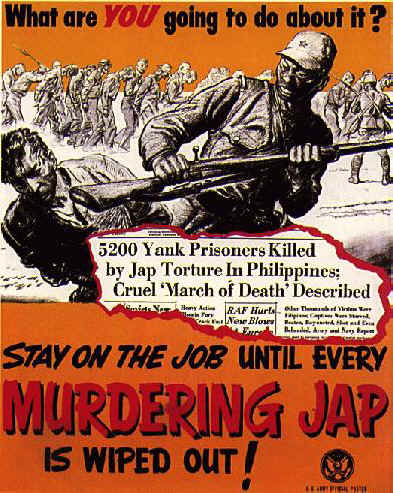
Propaganda

you can find this picture here

This propaganda is targeting the American audience during WWII. It will make the men fight harder because it makes them angry at the Japanese. This poster portrays the Japanese as pure vicious murderous killers with no apparent motive other than to torture and kill. The image of the japanese man kicking the American man down will stay in the men's minds as they fight because it gives them a purpose to fight and want to join the army to wipe out the Japanese. It asks, "What are YOU going to do about it?" and if the man reading it is not in the army and is just sitting at home, it will make him feel guilty and join. It's not misleading, but it does trick Americans into believing the worst in the Japanese. The tone is appropriate to the society because at this time Americans were in the middle of this big global war and needed the extra push to fight instead of sitting back in fear. What doesn't work is the hypocrisy of it. Murder the Japanese because they are murdering us? If we murder the Japanese back we will be just as bad as they are.

Wednesday, March 18, 2009

Dystopian Group

THE HANDMAID'S TALE - ANALYSIS OF THE SYMBOLS OF COLORS

Though the book lacks complex descriptions, Margaret Atwood seems to always describe the apparel of the characters with their colors. "There are several umbrellas in it: black, for the Commander, blue, for the Commander's Wife, and the one assigned to me, which is red." (Atwood 9). Red is often used, as well as blue, white and black. Each color, however, symbolizes the rank of the certain person. The handmaids always dress in red; it symbolizes their fertility, their ability to reproduce. Blue is worn by the Wives. This may be a stretch, but because this society thrives off of religious beliefs, blue is a representation of the Virgin Mary, as the wives are pure, untouched. White is worn by the daughters; a simple symbolization, where it represents their innocence; it is unknown whether or not they are fertile, if they will become unwomen, so they wear white to symbolize the clean slate. And black seems to be a common color for men, though it does not seem as important as the women's colors.

Wednesday, March 11, 2009

Dystopian Journal 1

Prompt A

"The newspaper stories were like dreams to us, bad dreams dreamt by others. How awful, we would say, and they were, but they were awful without being believable. They were too melodramatic, they had a dimension that was not the dimension of our lives. We were the people who were not in the papers. We lived in blank white spaces at the edges of print. It gave us more freedom. We lived in the gaps between the stories" (Atwood 56-57).

What is revealed about society from this passage?
People sit back because they are afraid to be different. In this society, being different, being outspoken, is dangerous, giving more emphasis on the fear of being different. The fertile women were blessed with the fact that they are able to bear children; it helps them blend in better. The society that is revealed shows that conformity is key in be able to be free; however, it is a different kind of free. To be different, and to get away with it, is liberation. But the kind of freedom you get from conforming into this society is the freedom to stay alive. Those who attempted to break the barriers of this society were put on display by these newspaper stories; showing that fear is key in this society. "Awful without being believable" - meaning, those who have chosen to conform to this society are led to believe that everybody is a conformist, and that nobody tries to break the barriers of this society. Though, without these people who tried to liberate themselves, the women who suffered to conform would no longer be able to live in the shadows.


word count - 188

Wednesday, March 4, 2009

ULGH

I can't figure out how to do outlining in Word! I followed the directions and nothing happens when I hit tab. Outlining would be a hundred times faster if I didn't have to manually drag everything to fit. So Frustrating. This just adds to my horrible week.

Tuesday, March 3, 2009

New Thesis

It's tweaked - I'm trying to only focus on one point, but it's hard because I want to write on so much!

Though to some it may seem to be a hindrance, Camus creates Mersault to accept the fact that he is only able to express himself physically with the inability to evoke emotion, which can be seen through the symbols of the sun, death, and his relationship with Marie.
What conclusion does Meursault come to at the end of the text? Does Camus want the reader to come to the same conclusion? Do you believe Meursault is happier or less happy at the end of the novel?

Mersault seems to come to the conclusion that no matter how different he seems to be from the rest of the world - the world actually possesses a kind of indifference, something that Mersault can relate to. I like that at the end, he shows emotion towards his mother, when before, he couldn't relate. Now that he himself was about to face death, he understood the emotions of his mother. These conclusions seem to give Mersault a sense of closure on his isolated life, a conclusion that Camus wanted the reader to feel as well, this book was very well-rounded and gave you a sense of a peaceful ending despite the fact that he is going to be executed.

Monday, March 2, 2009

Journal #6

Thesis:
Through the philosophy that
a man's life is his own responsibility, Mersault has built a wall between himself and society, where he is capable of expressing himself physically yet he cannot evoke meaningful thoughts and feelings, as can be seen through the symbols of the sun, darkness and death.


So here is my thought process...
- Question: Why does Camus keep Mersault's thoughts vague even though he is the narrator of the story?
- Mersault is telling a story without really investing any thoughts or feelings into the events
- The lack of knowledge of Mersault's thought process actually develops Mersault's character
- It shows how Mersault creates a wall between him and the world
- This barrier causes him to be convicted of murder, I could use the example of his mother, I really love that his philosophy impacts his reaction to his mother's death.
- Mersault is not able to express himself verbally, though he can go into detail on himself physically. He went into great detail of his physical feelings when he shot the Arab rather than his mentality.
- Though he did express that he had shattered his happiness, that rare look into his mentality was super vague
- Mersault really begins to open up in the last chapter, when he knows that he is about to die, we are really able to look into how he thinks
- The fact that this is the only time we really have a good look inside Mersault's mind makes it stand out even more.
- To incorporate the sun into my analysis: Mersault really expresses his feelings through the physical presence of the sun and how it affects him physically.
- Philosophy that a person's way of life is their choice and responsibility, therefore, it is Mersault's fault for his isolation. How to word that concisely..?!

Sunday, March 1, 2009

Journal Number Whaaa?

Why does Camus create a part 1 and a part 2? Identify parallel ideas or scenes that occur between the two parts. What does Camus accomplish by comparing ideas between the two parts?

Camus creates two parts to identify Mersault's choice in a simplictic life and him being forced to live simplictic. Simplictic, is that a word? By being put in jail, Mersault begins to actually think about his life, and his consequences for his actions, rather than living by the minute as he had before. It is a great way to further develop Mersault without making him any different. The fact that Mersault's actions when his mother died caused him to be executed really makes you feel for the guy - I mean, before, this was just a story about a man who can't really get his feelings across, and now, because of that, he's about to die. His view on life is somewhat morbid, and yet, it's his own philosophy, and it helps further understand his way of thinking: "Since we're all going to die, it's obvious that when and how doesn't matter." (114). This really ties back to Maman dying at the very beginning of the book, especially since Mersault wasn't sure exactly when she died, or how old she was. It ties the story together really well.